A Fair Rubric for Assessing Experience-Based Technical Skills

Executive summary
Plenty has been written about how candidates from nontraditional paths should translate their experience into resume language. Almost nothing has been written for the person on the other side of the table: the hiring manager, technical lead, or panel member who needs to decide whether eight years of running a supply chain afloat equals two years of operating an inventory platform — or maybe five, or maybe zero. When there is no degree to point to and no brand-name employer to lean on, the assessment itself has to do the work. Too often it does not. The interview becomes a vibe check, and the outcome depends more on the assessor's comfort with unfamiliar backgrounds than on the candidate's actual capability.
This paper offers a structured rubric for assessing experience-based technical skills: what to score, what evidence to accept, how to keep scoring consistent across candidates with wildly different histories, and how to keep the whole thing light enough that a small team will actually use it.
The deckplate gap in assessment
The deckplate gap here sits between two people. The candidate has real, hard-won judgment — the kind earned from things going wrong at inconvenient times. The assessor has a hiring bar they are accountable for, and usually no instrument for measuring that judgment other than conversation and instinct. The gap shows up as proxy questions: "Do you know this framework?" instead of "Have you made decisions like the ones this role makes?" Proxies are fast, and they systematically undervalue anyone whose experience is real but differently labeled. The candidate who ran a 40-person maintenance schedule through two deployment cycles gets scored lower than the candidate who completed a tutorial, because the tutorial's vocabulary matches the question.
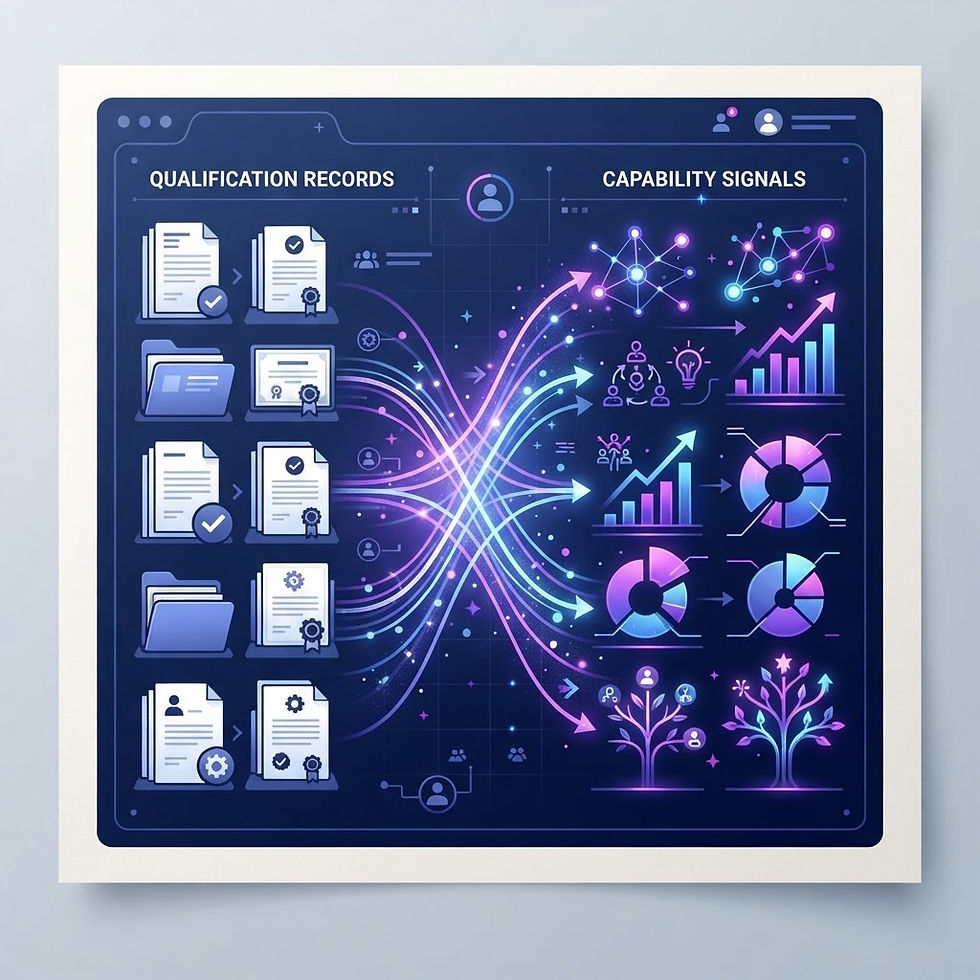
A rubric's job is to replace vocabulary-matching with evidence-scoring. It does not lower the bar. It makes the bar visible, which is fairer to strong candidates from every background — including conventional ones.
What to score: four dimensions
Build the rubric around four dimensions, each anchored in observable behavior rather than recalled terminology.
1. Judgment under ambiguity. Give a realistic scenario with missing information and ask what the candidate would do first. Strong candidates ask clarifying questions, name their assumptions out loud, and can say what would change their answer. The evidence you are scoring is not the final answer — it is the reasoning path. Candidates with operational experience tend to shine here, because they have genuinely been in situations where nobody had the full picture.
2. Learning velocity. Experience-based candidates will have gaps; the question is how fast the gaps close. Ask about something they had to learn from scratch and listen for the shape of the story: what triggered the learning, what they tried, what failed, how they knew they were competent. A concrete failure-and-recovery story is stronger evidence than a smooth success story, because it shows the learning loop actually works.
3. Ownership and follow-through. Ask for an example of something they were personally accountable for that went badly, and what happened after. Score for whether they can describe the cleanup, the fix to the underlying process, and what they would do differently — without blaming circumstances. Accountability under failure is one of the most transferable skills operational experience builds, and one of the hardest to fake.
4. Translation ability. Can the candidate explain a complex thing they did to someone who does not share their background? This is not about polish; it is about whether they can model what the listener knows and does not know. It predicts how they will work with your team, your customers, and your documentation.
Keeping it fair across very different histories
Consistency is the fairness mechanism. A rubric only works if every candidate runs through the same dimensions, scored against the same evidence standard. Three practices keep it honest:
Score evidence, not pedigree. Write the rubric so every score is justified by something the candidate said or did in the assessment, not by their resume's header. If a score cannot be traced to a specific moment in the conversation, it is a vibe, not a score.
Use the same scenario set. Prepare two or three realistic scenarios drawn from your actual work and use them with every candidate. Comparing different people against the same problem is the only way a small team's scoring stays calibrated. Rotate the scenarios quarterly so they do not leak.
Separate the debiasing step. After scoring, have each assessor write one sentence per dimension before discussing. Written-first scoring interrupts the anchoring that happens when the loudest voice in the room interprets a nontraditional background for everyone else.
Defining the score levels so they mean something
Three-level scoring only works if the levels are defined by evidence quality, not by feeling. "Not yet" means the candidate could not produce a concrete example, or the example was entirely hypothetical when a real one was asked for. "Developing" means there is a real example, but the candidate describes outcomes more than their own actions — lots of "we," little "I," and no moment where they personally decided something. "Strong" means a real example, a specific decision the candidate personally made, a visible trade-off or failure honestly named, and a lesson that shows the loop closed.
Write those definitions at the bottom of the rubric page. Assessors drift without them; two people on the same panel will silently calibrate "strong" to different standards within a single afternoon. The written definition is what makes scores comparable between the first candidate of the week and the last.
Keeping it lightweight
A rubric that takes four hours per candidate will be abandoned by a small team within a month. Keep it to one page: four dimensions, three score levels (not yet, developing, strong), one evidence line each. Fifteen minutes of prep, one page of notes per candidate. That is enough structure to change the outcome of the assessment without turning hiring into a compliance exercise.
Pilot it on the next three candidates for one role, then compare the scores you gave against what you would have said without the rubric. Where the two differ, the rubric is telling you something your instinct was missing — in either direction. That difference is the whole point.
Conclusion
Experience-based candidates are not asking for the bar to be lowered. They are asking for the bar to be measured. A one-page rubric that scores judgment, learning velocity, ownership, and translation — anchored in evidence and applied consistently — is fairer to them, more defensible for the assessor, and better at predicting who actually succeeds once hired. A modest instrument, used consistently, beats a rigorous one that exists only in the training slide deck.
Disclaimer
This article is for general informational purposes only and does not constitute legal, cybersecurity, workforce, or operational advice. BlueVioletApps LLC is an independent company and is not affiliated with, endorsed by, or sponsored by any federal agency, military branch, or government organization. Hiring and employment decisions must comply with applicable employment law; consult qualified professionals and the responsible authorities for your environment.


Comments