From Qualification to Confidence: Measuring Workforce Readiness

Executive Summary
Organizational success in technical and operational sectors depends on workforce readiness. Traditional workforce evaluation models rely heavily on paper qualifications, course completion certificates, military rating titles, and formal degree requirements. While these credentials provide a baseline measure of exposure, they frequently fail to predict whether an individual can execute complex duties independently under real-world operational pressure.
True workforce readiness extends beyond passive qualification; it represents demonstrated capability and operational confidence. Transitioning military veterans and technical specialists often possess substantial practical experience, leadership judgment, and decision-making skills under stress that are not reflected in standard civilian resume templates or course certificates. This white paper presents a framework for measuring workforce readiness through objective task decomposition, practical demonstration standards, structured gap training, and confidence metrics.
The Deckplate Gap in Qualification Records
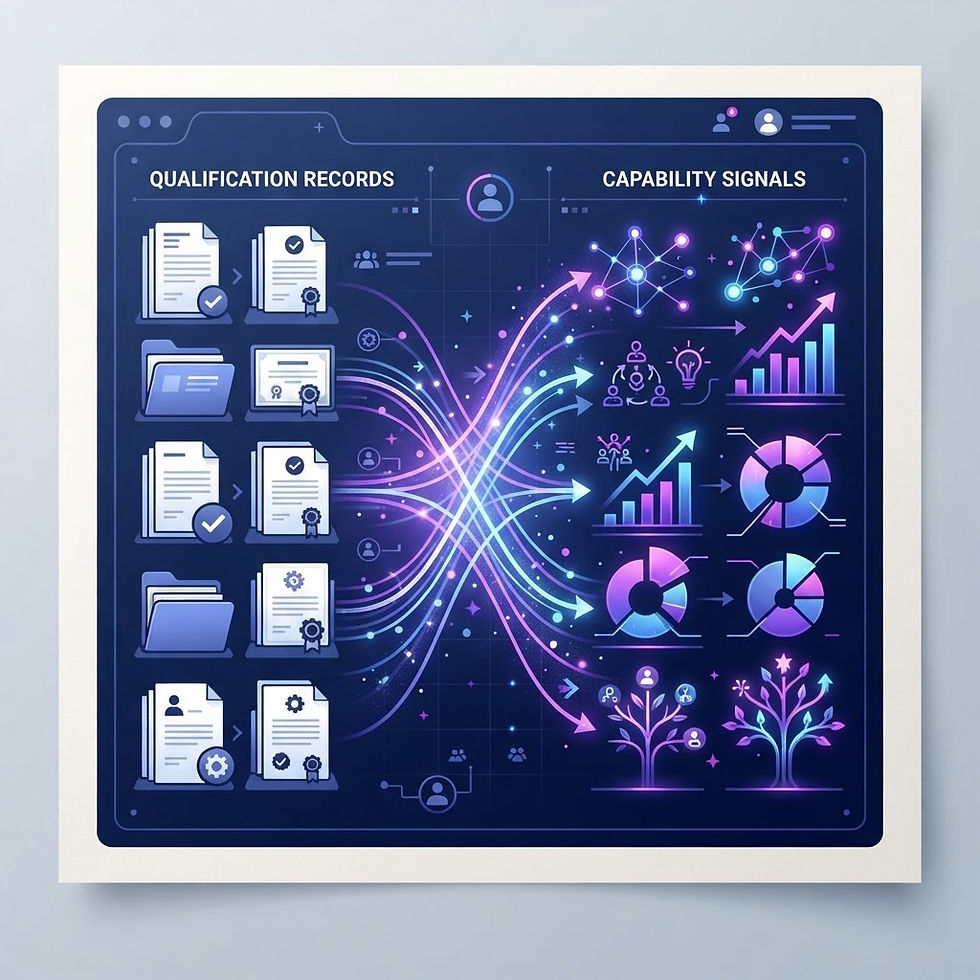
In military command structures and commercial technical enterprises alike, a significant divide exists between formal administrative qualification records and actual operational readiness on the deckplate. This discrepancy is known as the Deckplate Gap.
Administrative management systems track qualifications through completed training matrices, compliance checkmarks, and formal occupational specialty codes. However, on the deckplate, supervisors often discover that a technician holding a valid qualification certificate lacks the practical judgment, troubleshooting instinct, or confidence required to operate machinery or manage systems independently during an operational failure.
Conversely, transitioning military veterans often face the opposite side of the Deckplate Gap. A veteran Navy Petty Officer or Logistics Specialist may have years of hands-on experience managing complex supply chains, operating advanced electrical systems, or leading teams under severe operational constraints. Yet, when evaluated by civilian hiring systems relying on rigid keyword matching, their real-world capability is obscured by unfamiliar military titles. To build resilient technical teams, workforce systems must move past paper checkmarks and measure practical capability on the ground.
Deconstructing Experience: Tasks Over Titles
To evaluate workforce readiness accurately, organizations must abandon overreliance on formal job titles and focus on granular task decomposition. Job titles vary wildly across military services, defense contractors, and commercial tech sectors, masking underlying technical alignment.
Deconstructing experience requires breaking down past duties into five core competency vectors:
Scale and Environment: The operational volume, infrastructure complexity, budget scope, or headcount managed by the candidate in previous roles.
Operational Stakes: The operational risk environment, safety criticalities, time sensitivity, and potential consequences of error associated with past responsibilities.
Tooling and Methodologies: The foundational technical concepts, maintenance procedures, data systems, and operational frameworks utilized.
Decision-Making Authority: The degree of independent judgment, risk assessment, and decision-making autonomy granted to the individual.
Failure Triage and Problem Solving: Demonstrated ability to diagnose system anomalies, perform root-cause analysis, and execute corrective action under pressure.
By evaluating candidates across these five vectors, organizations can translate diverse backgrounds—including non-traditional military experience—into clear, defensible measures of technical readiness.
Establishing Practical Demonstration Standards
Paper examinations and multiple-choice tests measure rote memorization, not operational capability. Establishing true readiness requires implementing practical, performance-based evaluation standards.
Practical evaluations should simulate real operational environments and challenge candidates to complete representative tasks. For software, logistics, and technical maintenance roles, effective demonstration standards incorporate three key components:
Scenario-Based Technical Tasks: Presenting candidates with realistic operational scenarios—such as diagnosing a database performance bottleneck, resolving a supply chain discrepancy, or configuring a secure network route—and observing their execution.
Verbal Defense of Technical Choices: Requiring candidates to explain why they selected a specific solution, what trade-offs they evaluated, and how they accounted for potential failure modes. This tests operational reasoning rather than lucky execution.
Handling Injected Anomalies: Introducing unexpected operational changes or system faults mid-task to evaluate how calmly and methodically the candidate triages unexpected failures.
Performance-based evaluations provide objective evidence of capability, allowing hiring managers and technical directors to place individuals with confidence.
Building the Bridge from Qualification to Confidence
Recognizing existing capability is only the first step; organizations must also structure targeted pathways to build operational confidence in new environments. Moving an individual from initial qualification to independent operational confidence requires deliberate scaffolding:
Targeted Gap Training
Rather than forcing experienced hires through redundant, entry-level training programs, organizations should evaluate baseline capabilities and deliver targeted instruction focused strictly on specific delta skills—such as proprietary software tools, company documentation standards, or industry regulations.
Supervised Execution and Apprenticeship
New personnel should pair with experienced leads during initial operational rotations. Supervised execution allows individuals to apply their foundational knowledge while receiving real-time feedback and learning nuanced operational norms safely.
Rubric-Based Feedback Rhythms
Continuous feedback based on clear, objective rubrics removes ambiguity. Instead of vague feedback, supervisors provide specific observations regarding technical accuracy, safety protocol adherence, communication clarity, and execution speed.
Psychological Safety and Failure Analysis
Building confidence requires an operational culture where minor errors during training are treated as learning opportunities rather than disciplinary events. Conducting transparent, non-punitive debriefs after training exercises instills accountability while fostering the confidence needed to make decisive choices under pressure.
Practical Workforce Readiness Evaluation Checklist
Program managers, talent leads, and operational commanders can use this practical checklist to establish a confidence-based workforce readiness evaluation framework:
☐ Define Competency Baselines: Map essential role requirements to concrete operational tasks rather than general job titles or educational degree requirements.
☐ Develop Performance-Based Assessments: Create realistic, scenario-based technical evaluations that require candidates to execute tasks and defend their choices verbally.
☐ Implement Military Skill Translation Vectors: Evaluate veteran applicants against scale, stakes, decision authority, and technical vectors rather than relying on civilian keyword filters.
☐ Establish Supervised Operational Rotations: Pair newly qualified personnel with senior mentors for structured, hands-on operational shifts prior to granting independent sign-off.
☐ Conduct Objective Rubric Reviews: Evaluate worker progress using standardized, evidence-based rubrics to track movement from guided performance to autonomous execution.
☐ Track Post-Placement Retention and Growth: Monitor long-term placement metrics, operational error rates, and career progression to refine training and evaluation baselines continuously.
Conclusion
Workforce readiness cannot be measured by paper certificates or broad job titles alone. By addressing the Deckplate Gap, deconstructing experience into tangible competency vectors, mandating practical demonstration standards, and nurturing operational confidence, organizations build resilient, highly capable teams. This evidence-based approach unlocks talent, accelerates onboarding, and ensures that operational personnel possess the verified capability to perform when stakes are high.
Disclaimer: General professional perspectives only. Not official U.S. government, Department of Defense, or military policy or endorsement. Not legal or compliance advice.
Disclaimer
This material is for general informational and educational purposes only. It is independent of any federal agency, does not represent official policy, and is not legal, regulatory, cybersecurity, procurement, or professional advice. Organizations should validate decisions against their own requirements, risk tolerance, and qualified reviewers.


Comments