When a Green Status Hides a Stale Dependency

Updated: Oct 19
Executive summary
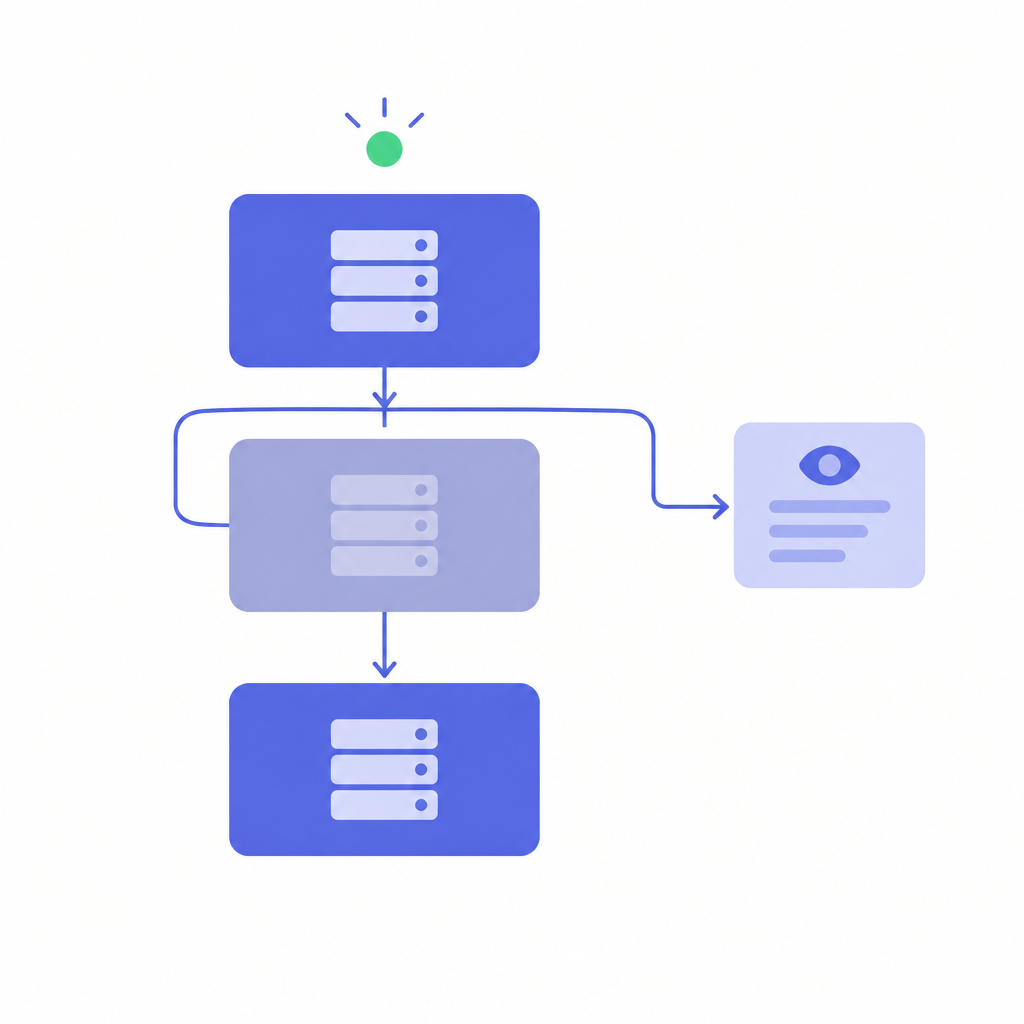
Status boards are good at answering one question: is my component running? They are usually silent on a second question that matters just as much: is the information my component depends on still current? A service can be perfectly healthy and completely blind, happily serving results computed from a feed that stopped updating two days ago. This post covers the failure pattern of green-but-stale dependencies and a practical design fix: propagate freshness from dependencies into your own status, so a stale upstream makes your status honestly degrade instead of lying green.
The failure pattern
The pattern usually surfaces after something goes wrong. An operator investigates a bad decision or an odd report, and the trail ends at a component whose own logs are clean, whose health checks pass, and whose data was last refreshed 52 hours ago. Nobody noticed because nothing was checking. The component's health check asked "are you up?" and it was. Nobody asked "is your picture of the world still true?"
This is distinct from the last-known-good problem, which is about what to display when data is stale. This is about what to display while data is quietly becoming stale — before anyone has noticed, while every indicator still says green.
Three kinds of dependencies that hide staleness
Feeds and syncs. Upstream systems that push or pull on a schedule. When the schedule silently stops — a token expired, an API changed, a job hung — your component keeps running on the final snapshot.
Caches. A cache hit rate that stays suspiciously high can mean the source stopped changing because it stopped updating. Green cache metrics, dead feed.
Reference data. Configuration, mappings, and catalogs that change rarely by design. Rarely-updated data trains everyone to ignore its timestamp, so when it does go stale, no alarm reflex exists.
Make dependency freshness part of your status
The fix is to treat upstream freshness as an input to your own health, not as someone else's problem.
Track the last-successful-refresh age for every dependency you rely on to make decisions. Not the last attempt — the last success. A sync job that fails every night and logs loudly is still leaving you on old data.
Define a freshness budget per dependency. Some feeds are useless after 15 minutes; some reference data is fine for a month. The budget comes from what decisions the data supports, not from the sync schedule. If a human would make a different decision with 6-hour-old data than with 6-minute-old data, that dependency has a real budget.
Degrade your own status when a dependency exceeds its budget. The key move: your component's status should move from green to an honest intermediate state — "running on data older than budget" — rather than staying green until it crashes. Amber-because-upstream is a different, more truthful signal than amber-because-overloaded.
Show the age, not just the color
Color-only status pushes staleness back into the shadows. Where an operator makes decisions, show the actual age against the budget: "feed: 4h old (budget 1h)". Numbers let an operator reason about severity; colors only let them react. A degraded state that explains itself — which dependency, how old, what budget — turns a status board into a decision surface.
One rule that earns its keep: never compute a status from a dependency's self-reported health alone. A dead feed reports nothing, which is not the same as healthy. Silence must be interpreted as staleness, and only your side can do that interpretation.
A same-day audit
List every external input your component uses to make a decision. For each, find the last-successful-refresh timestamp and where a human would see it. Most teams find at least one dependency whose staleness would be invisible to every existing indicator. Give that one a budget and an honest degraded state first — that is the one that will eventually cost a night of sleep.
Conclusion
Green status answers "is it running." It is silent on "is its world still true." Track last-successful-refresh age per dependency, set freshness budgets derived from the decisions the data supports, and let stale upstreams degrade your own status honestly. A status board that can say "healthy, but flying on old data" is worth more than one that can only say green.
Disclaimer
This article is for general informational purposes only and does not constitute legal, cybersecurity, workforce, or operational advice. BlueVioletApps LLC is an independent company and is not affiliated with, endorsed by, or sponsored by any federal agency, military branch, or government organization. Always validate requirements with qualified professionals and the responsible authorities for your environment.


Comments