Store, Forward, Verify: A Field Data Pattern for Intermittent Connectivity

Executive summary
Field work doesn't stop when connectivity does — inspections get performed, maintenance gets logged, readings get taken, and in many operational environments the network is intermittent by geography rather than by choice. Tools that assume a live connection handle this badly: the operator retries into a void, caches unsafely, or (worst of all) backfills data later with fabricated timestamps, producing a record that looks clean downstream and is quietly fiction. This paper describes a three-part pattern for building field-capable data capture on unreliable networks: local-first storage that makes the device the source of truth, forward queues that reconcile when connectivity returns, and verification that confirms what actually arrived — so the record is honest about gaps instead of hiding them.
The signature failure: honest-looking fiction
The goal of a field data tool is not to avoid gaps in the record — gaps are weather — but to keep them from being presented as completions. The naive live-connection app, when the network drops, produces a menu of bad outcomes: the busy operator enters the data after reconnection and enters the wrong time because the intent was to demonstrate completion, not the event time; the data is entered from memory the next morning and appears in the log as if recorded live then; or the app submits a straw snapshot of a form partially completed, which a cloud reader interprets as "nothing happened during the outage" instead of "unknown." Each failure, in its own way, is the same bad record — the fiction of a seen event, a definitive-looking record with a hand-waving relationship to reality.
The band-aid of caching-with-retry is unstable: caches are volatile, have silent eviction, and fail to answer the operator's second question after "was it submitted?" — which is "what do I still owe?" A better design separates three concerns that cache-and-retry tries to solve with a single fragile mechanism.
Part one: store — the device is the source of truth
When connectivity fails, field data is captured into a deliberate, durable local queue on the device — not a browser cache or session state, but a real local store (a lightweight database, a structured file, or platform offline storage) that holds each entry with the metadata that lets it be understood later:
Capture time versus event time, both recorded. The moment the operator fills it out, and the real-world time the event occurred when those differ; both must survive transmission, without overwriting each other, and appear in the durable record. This single decision addresses the single most confusing ambiguity in field data — "when was this actually done" cannot be reconstructed after the fact.
State assignment and visibility. Every entry has a display state — held locally, in queue, sent, confirmed — and the operator sees it at all times. This directly addresses the "what do I still owe?" question in a way that caching cannot: the operator holds positive confirmation of what has not left the vehicle yet, making the frustration of "did we lose it?" (the trigger for the retry-in-a-void behavior and the quietly-fabricated backfill) visible.
Capability to review and correct before sending. Time in the local queue is a narrow, precious window — the operator can review and fix a miskeyed serial number, or complete an incomplete form, before it goes, which is possible only while the record is still local. This is the same reason it makes sense not to send immediately even when connectivity is available: batch confirmation prevents most data-entry errors from ever leaving the truck (and makes anything still wrong — detected during verification, not after — the smaller class of found-in-the-field problems).
Part two: forward — reconciliation as a first-class process
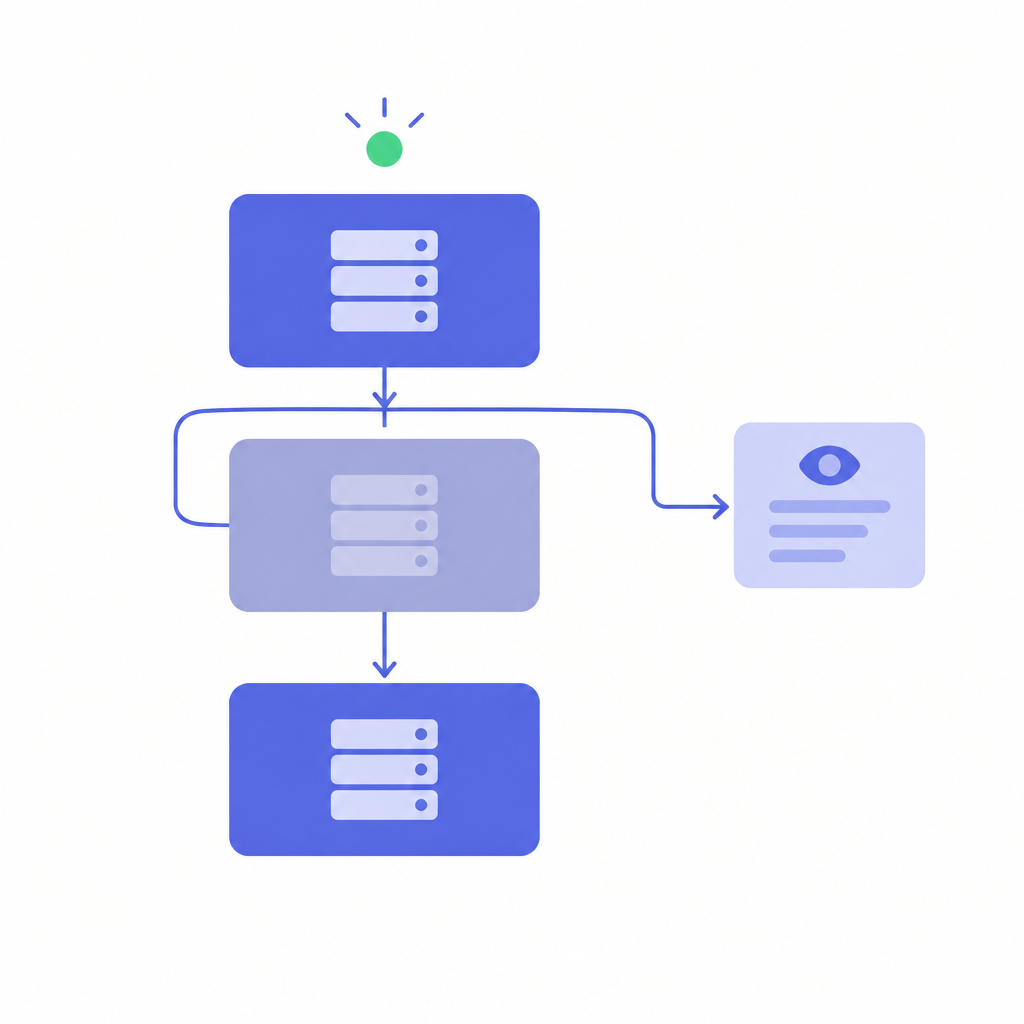
When connectivity returns, local entries transmit as a queue protocol, not a storage dump. The transfer requirement is reconstructable and idempotent: each entry transmits in sequence, duplicates are detected by identifier and accounted for rather than resent in confusion, and transmission is recorded on both ends. The field tool holds entries in a "sent, not yet confirmed" state until the server blesses receipt, instead of assuming silence equals success. This cleanly avoids the stale-result class of failure: resent duplicates that don't corrupt the record because the protocol detects them, and the queue not silently clears itself on a half-connection when in fact nothing fully left the field.
The connection window gets a usage plan because reconnection time is scarce: transmit the queue first (eliminate hand-off risk), then pull the direction the operator needs most — advisories, updates, next-task instructions — and finally run any bandwidth-heavy reconciliation or bulk downloads last, so a connection lost mid-window costs convenience rather than data.
Part three: verify — prove what arrived, mark what didn't
After the window, two verifications matter and they're distinct: the field device's received checks (server-confirmed states, no unexplained "sent" state left holding) and the backoffice view. Downstream, the record needs to be honest about coverage: a visible gap for "no data received from that vehicle on that date" instead of silent blankness, so that absent data reads as an open operating question rather than "checked and definitively nothing there."
The periodic audit that makes the whole pattern trustworthy is a reconciliation pass: local queue history on the device (a sending summary) vs. server-side receipt records, run by simple summary counts (entries sent, entries received, entries flagged). Small mismatches are investigated on the spot, and drift between what the field says was sent and what the server says appeared is caught here — every few weeks for stable deployments, more often during rollout. This one small comparison is the integrity story for the whole system: it lets the team say "the field record and the server record agree" — evidenced, not implied by the absence of complaints.
Building it small
The pattern fits small teams because each part degrades gracefully alone: store-first (with visible states) is an immediate improvement over cache-and-retry even with an otherwise naive forward mechanism; a real forward protocol improves on ad-hoc batch sends even without full reconciliation tooling; and verification via weekly count comparison needs nothing more than two log files and a diff. Complexity can be added in the same sequence as deployment maturity improves, and the operator-visible state list (held, queued, sent, confirmed) is the interface contract that customers and auditors can be shown on request.
Conclusion
Intermittent connectivity is a permanent feature of field operations, not a bug to be engineered around with bigger caches. The record survives it — honestly — when the device is a durable source of truth, transmission is a real reconcile protocol, and verification counts what actually arrived. Field data doesn't need the gaps hidden; it needs them recorded exactly as they happened, and the record the operator builds becomes the record the server can defend.
Disclaimer
This article is for general informational purposes only and does not constitute legal, cybersecurity, workforce, or operational advice. BlueVioletApps LLC is an independent company and is not affiliated with, endorsed by, or sponsored by any federal agency, military branch, or government organization. Always validate requirements with qualified professionals and the responsible authorities for your environment.

Comments