From Qualification Evidence to Job-Ready Confidence

Executive summary
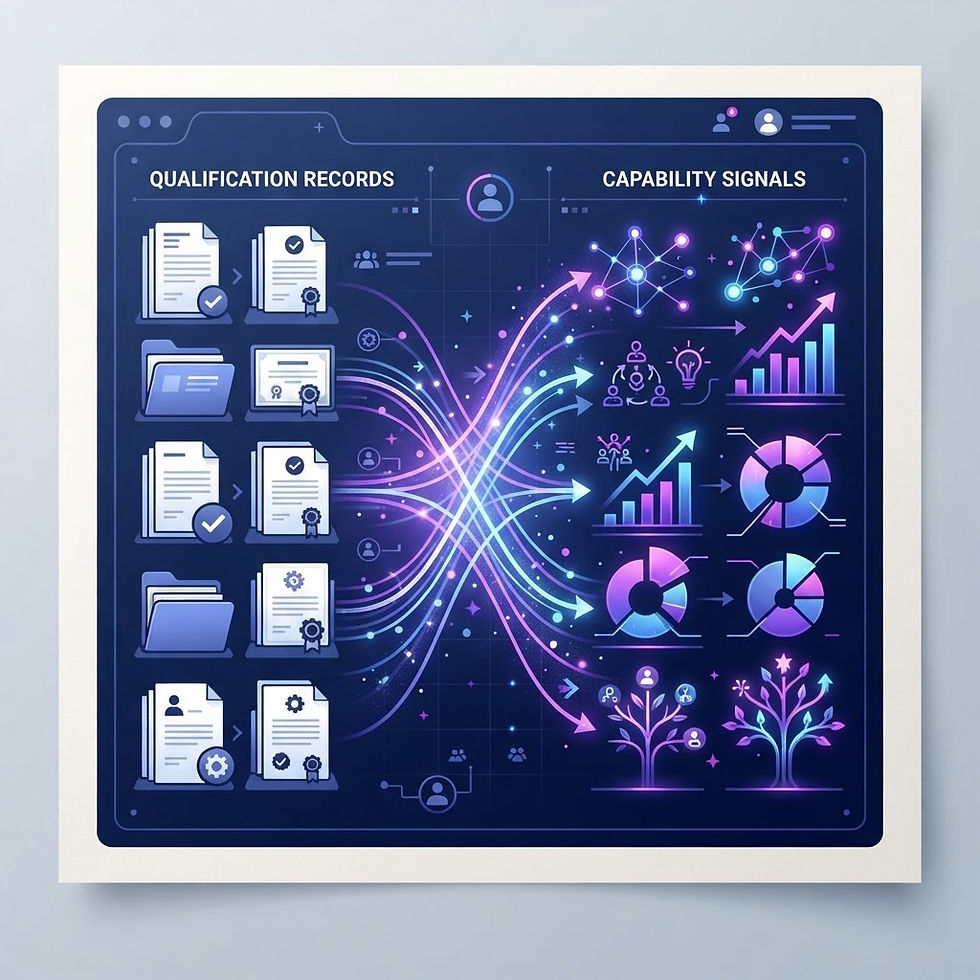
A qualification record confirms that a team member completed a course or earned a certificate, but does not prove they can stand watch and make sound operational decisions unsupervised. This paper presents an individual evidence framework for government contractors and small operational software teams. Replacing static credentials with a four-rung confidence ladder—trained, supervised, independent, and instructor—establishes observable evidence of readiness. The result is a defensible trail of individual capability that accelerates onboarding, supports veteran transition pipelines, and ensures operational reliability without administrative surveillance.
The deckplate gap in qualification records
In mission-critical operations, a qualification card records that an individual completed a check, but does not guarantee the watch stands itself smoothly when trouble starts. This disconnect is the deckplate gap. Standard training records capture structured milestones—exam scores, course completions, or sign-off sheets. Shift supervisors actually rely on individual judgment under pressure: knowing how a system behaves during anomalies, recognizing operational thresholds, and knowing when to request backup.
Consider an engineer certified on a system who has never seen the alarm nobody trained for. On paper, their credential matches that of a veteran operator. In practice, when an unscripted database error fires during a midnight change window, paper qualification offers no indication of whether the operator will panic, attempt an unauthorized patch, or follow an established escalation path. Supervisors need visible evidence of problem-solving, not a binary compliance record. Bridging the deckplate gap requires tracking how an individual demonstrates judgment during real operational workflows.
Building the individual confidence ladder
Evaluating individual readiness without relying on intuition requires a structured progression anchored in observable work artifacts. Rather than measuring aggregate team metrics, this framework tracks the practitioner across four explicit rungs:
Trained (Knowledge and Simulation): The practitioner understands the domain and standard procedures. Evidence includes completed modules, sandbox exercises, and verified assessments. The individual can explain required steps but has not executed them on live systems.
Supervised (Guided Execution): The practitioner performs live operations under direct oversight from a senior peer. Evidence includes co-authored deployment logs, peer-reviewed configuration changes, and documented shadowing notes.
Independent (Unsupervised Performance): The practitioner stands watch alone and manages routine operations independently. Evidence includes solo incident resolutions, accurate handovers, and decision logs during unexpected behavior.
Can Train Others (Evaluator and Mentor): The practitioner evaluates peers, updates playbooks, and guides junior team members. Evidence includes conducting walkthroughs, documenting exception patterns, and signing off on peer progression.
Advancing between rungs relies on verified artifacts rather than subjective impressions.
Tracking progression without surveillance bureaucracy
A common failure in workforce management is turning skills tracking into a burdensome surveillance state. When operators must log every minute of daily activity into a portal, compliance becomes a chore and data quality degrades.
To maintain trust, evidence capture must fit naturally into daily engineering routines. Supervisors gather evidence directly from standard operational outputs. A merged pull request with testing notes serves as evidence of guided execution. An incident review document authored after an off-hours response proves independent judgment. An updated runbook authored after an outage confirms an engineer can instruct others. If a tracking item does not directly inform a supervisor's decision to assign an unsupervised task, it should not be collected. Keeping evidence lightweight preserves focus on operational delivery while maintaining a transparent record.
Practical application for ops teams and veteran transition pipelines
This individual confidence model is especially valuable for government contractors, software operations teams, and veteran transition pipelines. Veterans entering the civilian technical workforce frequently possess strong foundational discipline, watchstanding rigor, and risk management experience, but their background may not align neatly with commercial resume buzzwords or vendor certificates.
A structured confidence ladder allows supervisors to evaluate transferable operational judgment immediately. A veteran with system monitoring experience in non-civilian environments can quickly demonstrate capability through supervised execution rungs, bypassing unnecessary entry-level coursework. For contractors and technical service teams, maintaining explicit, artifact-backed confidence records for each staff member provides a defensible audit trail for clients. It replaces speculative resume reviews with clear proof that every assigned team member is prepared for unsupervised duty.
Piloting the framework with one role
Adopting an individual confidence ladder does not require an enterprise overhaul. Teams should begin with a controlled pilot focused on a single operational role, such as a Junior Systems Operator or Site Reliability Engineer.
First, select three to five core operational tasks, such as executing a service deployment, triaging a system performance alert, or conducting a shift handover. Second, define the exact evidence artifact required for each rung. Third, pair pilot candidates with experienced evaluators who conduct structured walkthroughs during routine shifts. Finally, run the pilot for 30 days, gathering feedback from operators and supervisors to refine criteria. Once proven for one role, the framework can be expanded across the organization.
Conclusion
True operational readiness is built on individual trust supported by verifiable evidence. Paper qualifications establish baseline eligibility, but job-ready confidence develops as team members advance through a structured ladder of observed practice and sound judgment. By focusing on lightweight individual evidence trails, operations teams close the deckplate gap, empower veteran talent, and ensure that every watch is staffed by capable, independent practitioners.
Disclaimer
This article is for general informational purposes only and does not constitute legal, cybersecurity, workforce, or operational advice. BlueVioletApps LLC is an independent company and is not affiliated with, endorsed by, or sponsored by any federal agency, military branch, or government organization.


Comments